01 / Spatial computing
A moving world, from fewer views.
How much of a moving scene can we recover when we only see a little of it?
- My contribution
- Method design & experimental implementation
- Status
- Research manuscript
- Focus
- Gaussian splatting / PyTorch
a little movement, in another dimension
A cat, across
space and time.
50-second 4D Gaussian scene
Ziyi Li
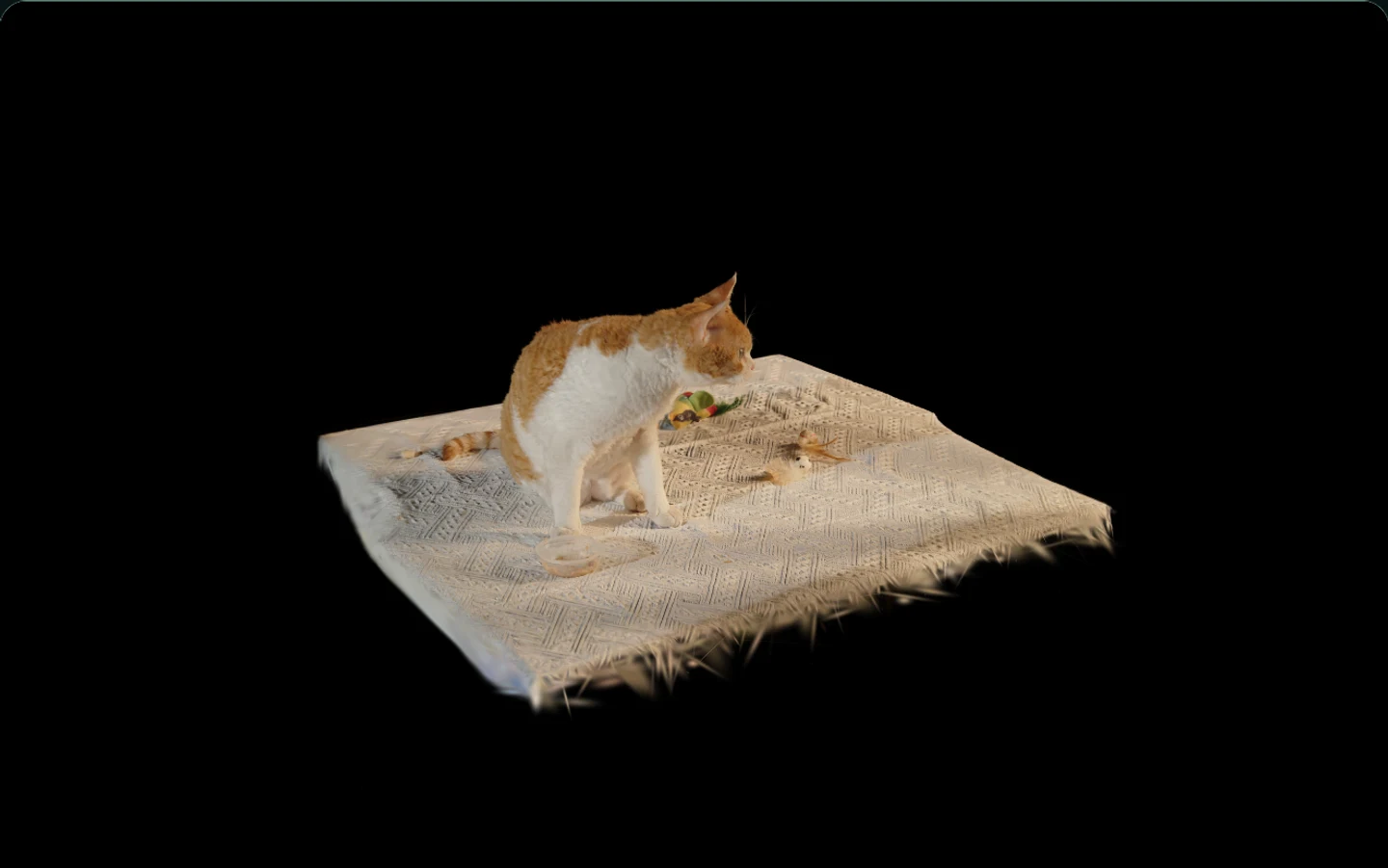
Press play to enter this scene.
Load when you’re ready. Drag to explore the scene, then use the timeline to move through time.
The question
Recover the scene. Keep the movement.
A photograph records one direction at one moment. A moving scene asks for more: what was hidden, where an object moved, and what another camera would have seen. My research explores a lightweight 4D Gaussian representation under sparse camera coverage.
My contribution
- Explored linear Gaussian trajectories with temporal gates as a compact representation for moving scenes.
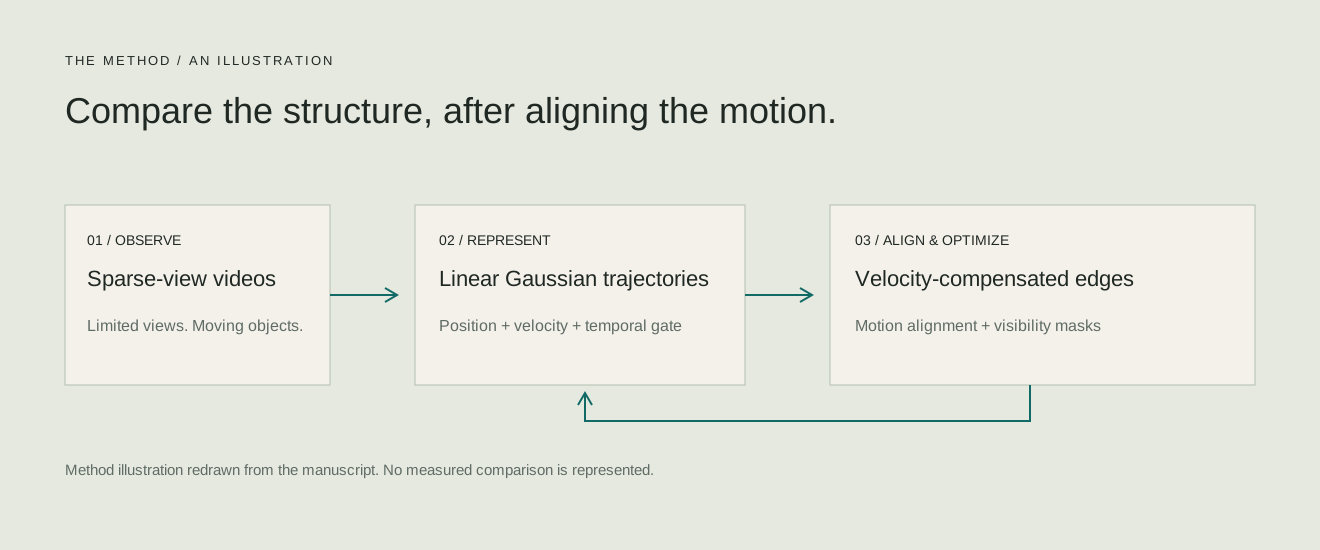
- Implemented velocity-compensated edge consistency (VCEC), aligning nearby renders before comparing their high-frequency structure.
- Developed motion-weighted and visibility-aware variants to examine blur, fast movement and occlusion.
How it works
01 / Represent motion simply
A Gaussian follows a linear spatial trajectory, while a temporal gate controls when it contributes to the scene. Fewer motion parameters constrain what the model can fit when observations are scarce.
02 / Align before comparing
VCEC uses estimated motion to bring adjacent renders into correspondence. Comparing edge structure after alignment is intended to avoid treating displacement as an error that should simply be blurred away.
03 / Account for visibility
Occlusion changes which evidence is trustworthy. Visibility masks limit the comparison, while a motion-weighted warm-up precedes the full alignment objective.
An important change
The manuscript develops baseline, motion-weighted (MER), and VCEC variants. The important shift is from asking adjacent images to look alike to asking corresponding moving structures to agree. That distinction guides both the loss design and the warm-up schedule.
A closer look at the motion model
The representation uses a linear trajectory μ(t) = μ₀ + vΔt and a temporal gate. VCEC aligns renders at nearby time steps using estimated motion, compares edge structure, and masks unreliable visibility. MER supplies an earlier motion-weighted optimization stage. This is an explanation of the proposed method, not a benchmark.
Evidence & boundaries
The method is documented in a research manuscript and an experimental implementation. My cat reconstruction and browser player provide a selected public 4D demo: explore the scene while its motion unfolds. The diagrams explain the method; the demo illustrates an interactive result without claiming quantitative gains.
Limits & next steps
Fast nonlinear motion, imperfect calibration and changing occlusions remain difficult. Piecewise trajectories and more reliable visibility checks are next directions. Quantitative gains and publication status are not claimed here.