02 / Participatory art
Who gets to write the label?
A machine mirror classifies. A person can refuse to be a fixed answer.
- My contribution
- Interaction concept & prototyping
- Status
- Installation prototype
- Focus
- Creative coding / React
The question
Being described is not the same as being understood.
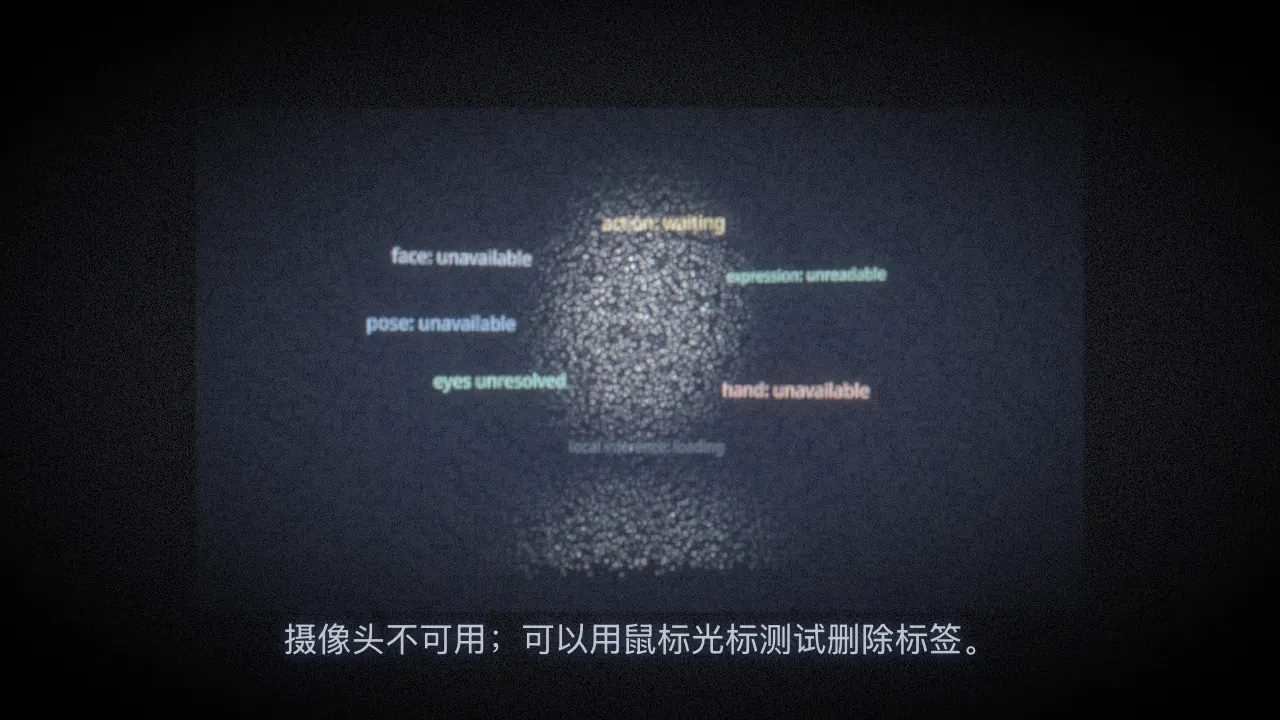
Theater of the Mind explores the gap between a machine reading and a person’s sense of self. In related prototypes, a mirrored figure becomes surrounded by labels. The work turns classification into something a participant can encounter, resist and change.
My contribution
- Prototyped a particle-based mirror and labels as a visual language for being classified.
- Explored gesture-driven rejection, expandable label rings, reset controls and a curtain that clears the stage on departure.
- Translated the label interaction into the small, keyboard-accessible web study below.
Web adaptation / Synthetic labels
An unfinished definition.
A small study in refusing and rewriting a label.
No camera. No inference. Your words stay on this page.
- a fixed answer
- easy to define
- predictable
- one thing only
Choose a label to reject or rewrite.
How it works
A figure becomes a field
The prototype samples an image into particles. Labels sit around the figure as an external reading, rather than a reliable description of the person.
The participant responds
The selected prototype includes gesture-driven label deletion, two controls for expanding and retracting rings, and a reset. Curtains close and clear the stage when a pose is no longer detected.
A small translation for the web
Here, authored labels and explicit buttons make one part of the interaction accessible without a camera. Rewrite is a new web adaptation of the creative intent, not a claim about a live exhibition feature.
A shift in agency
One prototype turned rejection into another label: resistance. Another gave participants controls to remove, retract and reset the reading. These versions explore different degrees of agency; the website isolates the second approach.
Evidence & boundaries
The image is an archived capture of the procedural fallback, not a photograph of a participant or proof of a completed exhibition. The later source revision supplies the interaction reference.
Limits & next steps
A tracking system can mistake loss of a pose for someone leaving. The installation prototype remains an experiment. This web adaptation uses synthetic labels, stores input only in page memory and makes no inference about the visitor.